On this blog I will talk about Rock´n´Roll women that I love. From Blues and Rockabilly, to Punk passing through 60s Garage Punk and 70s Glam, this is my tribute to the wonderful women of the Rock´n´Roll underground.
Please note that suggestions are welcome but there is no guarantee that I will publish it as this is a personal project.
Polly Jean Harvey (born 9 October 1969) is an English singer, songwriter, and musician. Primarily known as a vocalist and guitarist, she is also proficient with a wide range of instruments. As a teenager, she began learning saxophone and joined an eight-piece instrumental group Bologne, run by composer Andrew Dickson. She was also a guitarist with folk duo the Polekats, with whom she wrote some of her earliest material.
In January 1991, following her departure from Automatic Dlamini, Harvey formed an eponymous trio called PJ Harvey with former bandmates Rob Ellis and Ian Oliver. The trio released two studio albums called Dry (1992) and Rid of Me (1993) before disbanding, after which Harvey continued as a solo artist.
As Harvey embarked on her solo career, she explored collaborations with other musicians. In 1995 she released her third studio album, To Bring You My Love, featuring former bandmate John Parish, Bad Seeds multi-instrumentalist Mick Harvey and French drummer Jean-Marc Butty, all of whom would continue to perform and record with Harvey throughout her career. The album was also her first material to be produced by Flood. Simultaneously a more blues-influenced and more futuristic record than its predecessors, To Bring You My Love showcased Harvey broadening her musical style to include strings, organs and synthesisers. Since 1995, she has released a further nine studio albums.
Among the accolades Harvey has received are both the 2001 and 2011 Mercury Prize for Stories from the City, Stories from the Sea (2000) and Let England Shake (2011), respectively, making her the only artist to have been awarded the prize twice. She has also garnered eight Brit Award nominations, seven Grammy Award nominations and two further Mercury Prize nominations. Rolling Stone awarded her three accolades: 1992's Best New Artist and Best Singer Songwriter, and 1995's Artist of the Year. Rolling Stone also listed Rid of Me, To Bring You My Love, and Stories from the City, Stories from the Sea on its list of their 500 Greatest Albums of All Time. In 2011, she was awarded for Outstanding Contribution To Music at the NME Awards. In June 2013, she was awarded an MBE for services to music.
The Daughters of Eve were an American garage rock band formed in Chicago, Illinois in 1965. Thy are considered the first female rock band from Chicago, and the group released four singles during their existence before disbanding in 1968.
In late 1965, Carl Bonafede was seeking to form a sister group to accompany the other band he managed, The Buckinghams. After several auditions, the original lineup of singers and guitarists Judy Johnson and Marsha Tomal, bassist Andrea Levin, and drummer Debi Pomeroy was rounded. The band choose the local Senn High School as their launching point to attract a local following. For their act, Pomeroy became the early centerpiece of the group's sound for her standout performance at the drums. Once the band became well known in Chicago, they began touring within the Midwest, and opened for contemporaries in the Chicago rock scene like The Shadows of Knight, The Cryan' Shames, and The Buckinghams. Since the bandmates were under the age of 16, many of the clubs they performed in required adult supervision and forbidding them to sit outside the stage. The first non-ballroom performance by the band was in February 1966 at the annual Chicago Auto Show held in the McCormick Place by Chicago's lakefront. The band was featured as a backing band in local programming with Janis Ian to support the release of her song "Society's Child". In 1966, the band signed to a contract with USA Records to produce their first single "Hey Lover" b/w "Stand by Me" and their second one, "Symphony of My Soul" b/w "Help Me Boy". They both failed to chart nationally, but it became a popular release in the Chicago area that they would tour to promote. For their next releases, the band changed bass players, first with Marilou Davidson and then Lori Wax.
Their third single, "Don't Waste My Time" b/w "He Cried" was released on the Spectra Sound label in 1967, and their final single, "Social Tragedy" b/w "A Thousand Stars" on the Cadet label in 1968. "Social Tragedy" featured vocal harmonies conducted by Tomal and Johnson. The releases showed development of the band's sound from garage rock to including psychedelic rock influences. They still held the status as a popular regional act, but by the end of 1968 the group disbanded.
The Dixie Cups are an American pop music girl group of the 1960s. They are best known for a string of hits including their 1964 million-selling record "Chapel of Love", "People Say", and "Iko Iko". The trio consisted of sisters Barbara Ann and Rosa Lee Hawkins; plus their cousin Joan Marie Johnson, from New Orleans. They first sang together in grade school. Originally, they were to be called Little Miss and the Muffets, but were named the Dixie Cups just prior to their first release.
In 1963, the trio decided to pursue a professional career in music and began singing locally as the Meltones. Within a year Joe Jones, a successful singer in his own right with the Top Five 1960 single "You Talk Too Much," became their manager. After working with them for five months, Jones took them to New York City, where record producers/songwriters Jerry Leiber and Mike Stoller signed them to their new Red Bird Records. The Dixie Cups debut single was "Chapel of Love," which became their biggest hit reaching number one on the Billboard Hot 100 Chart in June 1964. It sold over one million copies, and was awarded a gold disc.
The group also had several other hits including, "People Say" (#12, 1964), "You Should Have Seen the Way He Looked at Me" (#39, 1964), "Little Bell" (#51, 1965), and "Iko Iko" (#20, 1965). "Iko Iko", a New Orleans traditional song, was recorded in 1964 but later was released as a single early in 1965. Barbara Hawkins had heard her grandmother sing the song, first recorded in 1953 as "Jock-a-Mo" by James "Sugar Boy" Crawford.
In 1965, the Dixie Cups moved to the ABC-Paramount record label before a recording hiatus in 1966 temporarily halted their careers. The Dixie Cups continued to tour as a trio with another New Orleans singer, Beverly Brown, replacing Joan Johnson. Brown who had recorded two solo discs in the early 1960s stayed as the third member until the early 80s when she became ill and was replaced by Dale Mickle. The Dixie Cups continue to perform and make personal appearances. The current line-up consists of the Hawkins sisters along with Athelgra Neville, sister of the singing Neville Brothers. On August 29, 2005, Hurricane Katrina swept through Louisiana, flooding much of New Orleans and displacing Barbara and Rosa Hawkins, who subsequently relocated to Florida. Joan Johnson relocated to Texas. Two years later in April 2007, The Louisiana Music Hall Of Fame honored The Dixie Cups for their contributions to Louisiana music by inducting them into The Louisiana Music Hall of Fame.
Joan Marie Johnson died in New Orleans of congestive heart failure on October 3, 2016 at the age of 72.
Mary Ford (born Iris Colleen Summers; July 7, 1924 – September 30, 1977) was an American vocalist and guitarist, comprising half of the musical team Les Paul and Mary Ford. Between 1950 and 1954, the couple had 16 top-ten hits, including "How High the Moon" and "Vaya con Dios", which were number one hits on the Billboard charts. In 1951 alone they sold six million records. With Paul, Ford became one of the early practitioners of multi-tracking.
By 1943, Colleen Summers, with Vivian Earles and June Widener formed the Sunshine Girls, a western trio who sang backup to Jimmy Wakely and his trio. They were regulars on The Hollywood Barn Dance, a successful weekly CBS Radio program broadcast on Saturday nights, and hosted by Foy Willing and emceed by Cliffie Stone. In 1944, the Sunshine Girls trio appeared with Wakely in the PRC film I'm from Arkansas, where they sang "You Are My Sunshine" and "Whistlin' (Walkin') Down the Lane With You" with Wakely. In 1945, when Eddie Dean introduced her to guitarist Les Paul, she was a popular western vocalist on KXLA's Dinner Bell Round-Up Time. The two began performing together in 1946. After Summers left the Sunshine Girls to work with Paul and his trio, she was replaced initially by Marilyn Myers Tuttle. After Tuttle left, Summer's older sister, Eva, sang with Earler and Widener as the Three Rays on the Jimmy Wakely Show on CBS. Colleen Summers appeared on Gene Autry's Melody Ranch CBS radio program as a cast member and featured vocalist from July through early November 1946.
By the summer of 1949, Summers was performing under the stage name of Mary Ford. Ford and Paul were music superstars during the first half of the 1950s, putting out 28 hits for Capitol Records between 1950 and 1957, including "Tiger Rag", "Vaya con Dios" (11 weeks at #1), "Mockin' Bird Hill" (top 10), "How High the Moon" (nine weeks at #1), "Bye Bye Blues" and "The World Is Waiting for the Sunrise". These songs featured Ford harmonizing with herself, giving the vocals a novel sound. Paul and Ford did all their recording at home or on the road and submitted the masters to Capitol, with Paul dictating to the record company what songs were destined to become hits. Paul and Ford also used the now-ubiquitous recording technique known as close miking, where the microphone is less than six inches from the singer's mouth. This produces a more intimate, less reverberant sound than when the singer is a foot or more from the microphone (see proximity effect). It also emphasizes low-frequency sounds in the voice. The result was a singing style that diverged strongly from earlier styles, such as vocals in musical comedies of the 1930s and 1940s.
After extensive touring and recording, the couple decided to leave Hollywood and moved to New York City to make the crossover from radio to television. They took a cramped apartment in Paul's former New York neighborhood, where they conceived and recorded their arrangement of "How High The Moon", a hard-swinging multi-layered arrangement containing twelve overdubs using the guitar and Ford's voice. While Capitol was reluctant to release this song, after they had scored several more hits with Capitol, including, 'Tennessee Waltz" and "Mockin' Bird Hill", "How High The Moon" was released in March 1951. Within a month, "How High The Moon" and "Mockin' Bird Hill" captured Your Hit Parade's number one and number two spots, respectively. During 1951, Ford and Paul earned $500,000, and had recorded more top ten hits for the year than Bing Crosby, Frank Sinatra, and The Andrews Sisters combined. They also tied Patti Page for top selling recording artist, having sold more than six million records since January 1951.
In 1953, the couple recorded "Vaya con Dios" (Capitol 2486), the biggest-selling song of their career, which was released in June 1953, entered the Billboard charts on June 13, 1953, and reached number one on August 8 and remaining there for a total of nine weeks. The song lasted thirty-one weeks on the chart, and also reached number one on the Cash Box chart. Following this success of "Vaya con Dios", in 1953 the couple started to host The Les Paul and Mary Ford Show, their own daily television program broadcast from their Mahwah home. The show, which was five minutes long and sponsored by Listerine, ran from 1953 to 1960 on NBC television and in syndication. In early 1955, rock and roll came along and eventually threatened the popularity of many performers including Paul and Ford. In July 1958, Paul and Ford left Capitol and signed with the Columbia label, but the move failed to restore their declining career.
In November 1963, Ford released her first solo single, an English-language version of "Dominique", for Calendar Records. Ford and her sisters were used as vocalists on Foy Willing's album The New Sound of American Folk, which was recorded at their brother Bobby Summers' Sound House Recorders in El Monte, California, and released on the Jubilee label.
Ford succumbed to complications of alcohol abuse in 1977. After eight weeks in a diabetic coma, she died in Arcadia, California, at the age of 53.
Shirley Marie O'Garra (stage name Shirley Ellis, January 19, 1929 – October 5, 2005) was an American soul music singer and songwriter of West Indian heritage. She is best known for her hits "The Nitty Gritty" (1963, US no. 8), "The Name Game" (1964, US no. 3) and "The Clapping Song" (1965, US no. 8 and UK no. 6). "The Clapping Song" sold over 1 million copies and was awarded a gold disc.
By 1954, Ellis had written two songs recorded by the Chords. As a singer, the Bronx-based teen won Amateur Night at the Apollo Theater in Harlem while also performing as a member of the Metronomes. All her solo hits were written by her and her manager, record producer, and songwriting partner Lincoln Chase. The pair worked ceaselessly together over the following years on perfecting every aspect of her talent. A tentative release for the small Shell logo in 1961 marked the recording bow of Shirley Elliston.
It was not until the fall of 1963 that the years of preparation paid off with the diminutive thrush's Congress label debut, the incredibly exciting "The Nitty Gritty". Shirley Ellis, after years of grooming, became an overnight Top 10 hitmaking sensation. Although she didn't quite explain the meaning of "The Nitty Gritty", the listener instinctively sussed that it was the unadorned kernel of reality at the heart of anything and everything. The phrase grabbed the imagination of society's mainstream and is enshrined in the common vocabulary to this day. As Christmas 1964 lurched ever nearer, Shirley bounced back onto the charts with a bullet. The convoluted craziness of "The Name Game" was impossible to withstand and would become the singer's biggest hit. She proved a sensation on Murray the K's Brooklyn Fox Holiday Show that winter, taking "Name Game" requests from the crowd. Her third Top 10 smash finally brought the star recognition in Britain and many other territories but "The Clapping Song" would prove impossible to top.
Shirley was then signed by Columbia. She registered her chart swan song with the memorable "Soul Time", the second of a trio of 45s for her new outlet. A June 1967 Columbia album, her third in all, was the last we heard from Shirley. Although she was reported to have then pacted with the Bell label, no records were forthcoming and she vanished into retirement in 1968.
She died on October 5, 2005 in New York City at the age of 76.
Amy Taylor is the front woman of Australian punk band Amyl and the Sniffers. The band is based in Melbourne, Australia and consists of vocalist Amy Taylor, drummer Bryce Wilson, guitarist Dec Martens, and bassist Fergus Romer.
The band was formed by housemates Taylor, Wilson, and Martens and former band member Calum Newton (AKA Candy) in Balaclava, Melbourne. The four wrote, recorded, and released their first EP, Giddy Up, in a span of 12 hours. Calum left the band to pursue solo music and was replaced by Fergus Romer. Their sound has been compared to 1970s hard rock groups such as Iggy Pop and The Stooges and The Damned.[2] However, Taylor has cited a number of varying influences including Minor Threat, Ceremony, AC/DC, Sleaford Mods, Dolly Parton, and Cardi B.
The band was signed to Homeless Records in July 2017 and Big Attraction/Giddy Up was released on 12 January 2018. Big Attraction/Giddy Up reached #8 on the UK Top 40 (Vinyl Charts) in March 2018. The band was signed to Rough Trade Records later in 2018, and went into the studio to record their debut album with producer and former Add N to (X) drummer Ross Orton. The result was the self-titled Amyl and the Sniffers, which was released on 24 May 2019 and has received generally positive reviews including a 7.2 from Pitchfork and 4 out of 5 stars from NME and Allmusic. In light of the album's release, Happy Mag placed the band at no.9 on their list of "The 15 Australian female artists changing the game right now", praising front-woman Amy Taylor for being "one of hardest rocking people on the face of the planet."
At the ARIA Music Awards of 2019, Amyl and the Sniffers won the Best Rock Album category. In February 2020, the self-titled album was nominated for the Australian Music Prize of 2019.
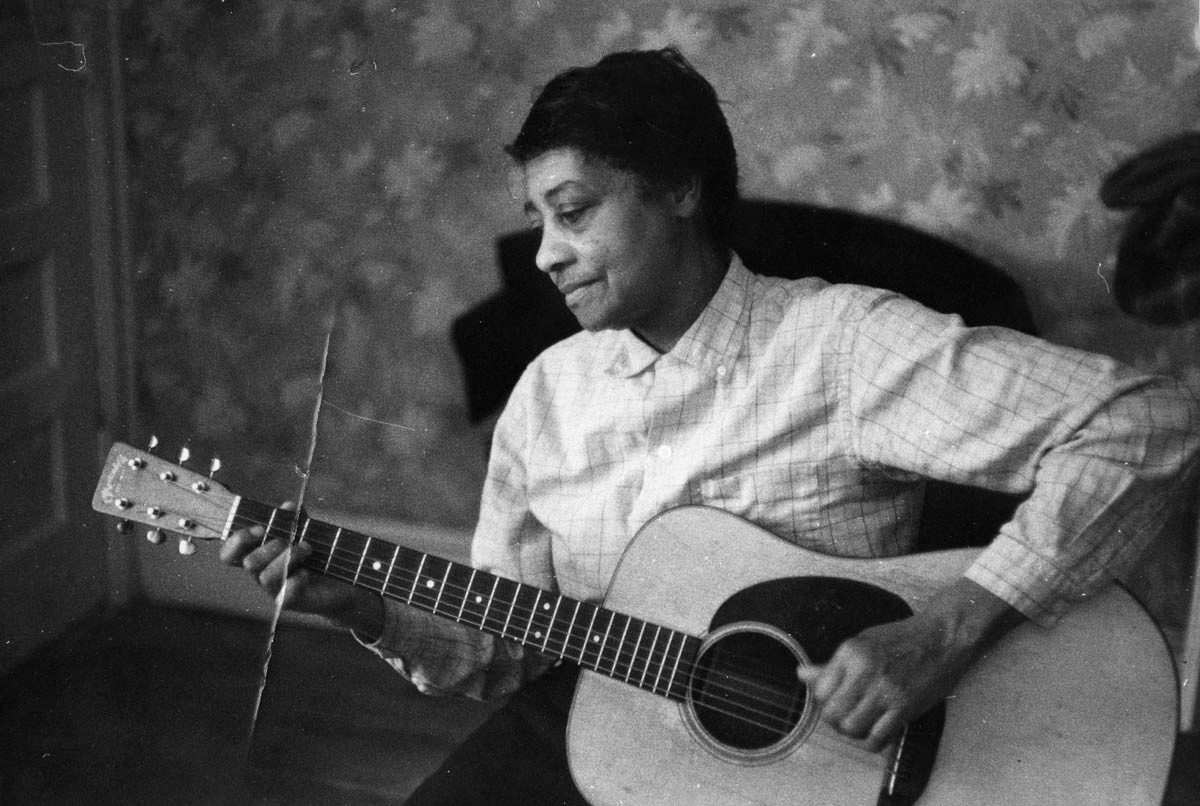
Elizabeth "Libba" Cotten (née Nevills) (January 5, 1893 - June 29, 1987) was an American blues and folk musician, singer, and songwriter. A self-taught left-handed guitarist, Cotten developed her own original style. She played a guitar strung for a right-handed player, but played it upside down, as she was left-handed. This position meant that she would play the bass lines with her fingers and the melody with her thumb.
Cotten was born in 1893 to a musical family near Chapel Hill, North Carolina, in an area that would later be incorporated as Carrboro. At age 9, she was forced to quit school and began work as a domestic. At the age of 12, she had a live-in job at Chapel Hill. She earned a dollar a month, that her mother saved up to buy her first guitar. The guitar, a Sears and Roebuck brand instrument, cost $3.75 (equivalent to $107 in 2019). Although self-taught, she became proficient at playing the instrument, and her repertoire included a large number of rags and dance tunes. By her early teens, she was writing her own songs, one of which, "Freight Train", became one of her most recognized. She wrote the song in remembrance of a nearby train that she could hear from her childhood home. The 1956 UK recording of the song misappropriated by Chas McDevitt and Nancy Whiskey was a major hit and is credited as one of the main influences on the rise of skiffle in the UK. Under the advocacy of the influential Seeger family, the copyright was eventually restored to Cotten. Nevertheless, it remains mis-credited in many sources.
Cotten retired from playing the guitar for 25 years, except for occasional church performances. She did not begin performing publicly and recording until she was in her 60s. She was discovered by the folk-singing Seeger family while she was working for them as a housekeeper. In the later half of the 1950s, Mike Seeger began making bedroom reel-to-reel recordings of Cotten's songs in her house. These recordings later became the album Folksongs and Instrumentals with Guitar, which was released by Folkways Records. Since the release of that album, her songs, especially her signature song, "Freight Train" - which she wrote when she was a teenager - have been covered by Peter, Paul, and Mary, Jerry Garcia, Bob Dylan, Joe Dassin, Joan Baez, Devendra Banhart, Laura Gibson, Laura Veirs, His Name Is Alive, Doc Watson, Taj Mahal, Geoff Farina, and Country Teasers.
Shortly after that first album, she began playing concerts with Mike Seeger, the first of which was in 1960 at Swarthmore College. In the early 1960s, Cotten went on to play concerts with some of the big names in the burgeoning folk revival. Some of these included Mississippi John Hurt, John Lee Hooker, and Muddy Waters at venues such as the Newport Folk Festival and the Smithsonian Festival of American Folklife. The newfound interest in her work inspired her to write more songs to perform, and in 1967 she released a record created with her grandchildren, which took its name from one of her songs, "Shake Sugaree". The song featured 12-year-old Brenda Joyce Evans, Cotten's great-grandchild, and future Undisputed Truth singer.
Cotten died in June 1987, at Crouse-Irving Hospital in Syracuse, New York, at the age of 94.