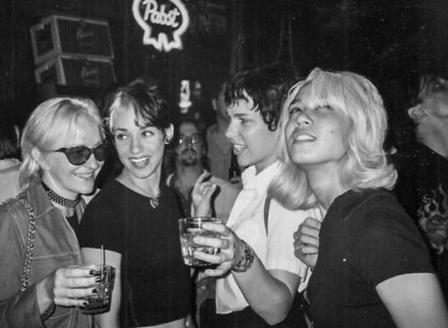
On this blog I will talk about Rock´n´Roll women that I love. From Blues and Rockabilly, to Punk passing through 60s Garage Punk and 70s Glam, this is my tribute to the wonderful women of the Rock´n´Roll underground.
Please note that suggestions are welcome but there is no guarantee that I will publish it as this is a personal project.
Red Aunts were an American all-female punk band that formed in 1991 in Long Beach, California, United States, when Terri Wahl (a.k.a. Angel, or Louise Lee Outlaw) recruited friends Kerry Davis (a.k.a. Sapphire, or Taffy Davis) and Debi Martini (a.k.a. E.Z. Wider, a.k.a. Connie Champagne, or Debbi Dip).Wahl would become the guitarist, sharing vocal duties with Davis who also played rhythm guitar and Martini as bassist. Jon Wahl of the band Claw Hammer, stood in as drummer under the alias Joan Whale until he was replaced full-time by Lesley Ishino (a.k.a. Lesley Noelle, Ishino Destroyer, or Cougar).
None of the women had formal musical training or previous experience in bands. Dip put out the punk fanzine, Real Life in a Big City. The Red Aunts rapidly developed their own sound, going from raw simple punk to more complicated garage-punk-blues within the space of their seven years and five full-length albums.
Their first single was released in 1992 and the band quickly gained local notoriety for the unique take on punk rock the band produced, loud, brash, raw and full use of distortion pedals. The band released it's full length debut album in 1993, "Drag" , this began the constant touring and soon caught the eye of the infamous LA based punk giant label Epitaph Records. Even though the Red Aunts by some standards failed to achieve what some bands of the Epitaph label may have in terms of commercial success, the doors the band helped open for future women in punk rock music and the countless female musicians to follow after due to the band's lead, far surpasses what most of the other Epitaph bands may have done. The Red Aunts would make five total albums and numerous singles before calling it a day in 1998 when bassist Debi Martini wanted to take a break. Other members have gone on to work with other bands like The Screws, Beehive and the Barracudas and others. Singer and guitarist Kerry Davis currently records under the name Two Tears. The band played at Funtastic Dracula Carnival in 2018. Debi Martini died in 2019.
Fontella Marie Bass (July 3, 1940 – December 26, 2012) was an American R&B and soul singer and songwriter best known for her number-one R&B hit "Rescue Me" in 1965.
Fontella Bass was born in St. Louis, Missouri. She was the daughter of gospel singer Martha Bass, who was a member of the Clara Ward Singers, and the older sister of R&B singer David Peaston. At an early age, Fontella showed great musical talent. At the age of five, she provided the piano accompaniment for her grandmother's singing at funeral services, she sang in her church's choir at six, and by the time she was nine, she had accompanied her mother on tours throughout the South and Southwest America. Bass continued touring with her mother until age of sixteen. As a teenager, Bass was attracted by more secular music. She began singing R&B songs at local contests and fairs while attending Soldan High School from which she graduated in 1958. At 17, she started her professional career working at the Showboat Club near Chain of Rocks, Missouri. In 1961, she auditioned for the Leon Claxton carnival show and was hired to play piano and sing in the chorus for two weeks it was in town. It was during this brief stint with Claxton that she was heard by vocalist Little Milton and his bandleader Oliver Sain who hired her to back Little Milton on piano for concerts and recording. Bass originally only played piano with the band, but one night Milton didn't show up on time so Sain asked her to sing and she was soon given her own featured vocal spot in the show.
Bass recorded several songs released through Bobbin Records She was produced by Ike Turner when she recorded on his labels Prann and Sonja. Her single "Poor Little Fool" released from Sonja in 1964 features Tina Turner. Two years later she quit the Milton band and moved to Chicago after a dispute with Oliver Sain. She auditioned for Chess Records, who immediately signed her as a recording artist to the subsidiary label Checker Records. Her first works with the label were several duets with Bobby McClure, who had also been signed to the label. Released early in 1965, their recording "Don't Mess Up a Good Thing" (credited to Oliver Sain) found immediate success, reaching #5 on the Billboard R&B chart and peaking at #33 on the Hot 100. Bass and McClure followed their early success with "You'll Miss Me (When I'm Gone)" that summer, a song that had mild success, reaching the Top 30 on the R&B chart, although it made no significant impression on the pop chart. After a brief tour, Bass returned to the studio.
That year, Bass co-wrote and recorded the song "Rescue Me" which shot up the charts in the fall and winter of 1965. After a month-long run at the top of the R&B charts, the song reached #4 on the US pop charts and #11 in the UK, and gave Chess its first million-selling single since Chuck Berry a decade earlier. It sold over one million copies, and was awarded a gold disc. Bass followed with "Recovery," which did moderately well, peaking at #13 (R&B) and #37 (pop) in early 1966. The same year brought two more R&B hits, "I Can't Rest" (backed with "I Surrender)" and "You'll Never Know." Her only album with Chess Records, The New Look, sold reasonably well, but Bass soon became disillusioned with Chess and decided to leave the label after only two years, in 1967.
Tired of the mainstream music scene, she and husband Lester Bowie left America and moved to Paris in 1969, where she recorded two albums with the Art Ensemble of Chicago – Art Ensemble of Chicago with Fontella Bass and Les Stances a Sophie (both 1970).
The next few years found Bass at a number of labels, but saw no notable successes. After her second album, Free, flopped in 1972, Bass retired from music. On December 26, 2012, she died at a St. Louis hospital from complications of a heart attack suffered earlier in the month; she was 72.
Glamazon comes at you with the musical
force of a Hurricane! One of the few rock bands with a transgender lead singer who also plays guitar, Glamazon blazed the trail of musical innovation in the mid 90s. Electronica meets Metal Rock.
Transgendered Lead Singer-Guitarist Christine Beatty and guitarist Shredmistress Rynata created a rock spectacle that was ahead of its time and still amazes audiences world wide! Their material combines aggressive metal with sophisticated electronica and midi equipment. A super-sonic experience as several critics put it. Granted, Glamazon could easily be dismissed as a novelty act or full of Gimmickry but make no mistake: Those two rock divas SHRED and their material is stellar.
Christine was born a boy and transitioned into a beautiful, talented woman. Her experiences as a transgendered woman and rock musician are detailed in her extensive writing, as well as song material for Glamazon. In 1993 Christine Beatty co-founded and performed in Glamazon, one of the first transsexual-fronted heavy metal rock bands. The band performed for the first time in San Francisco at Bottom of the Hill in February 1995, recorded its only released CD in 1995-1996, and moved to Los Angeles in 1999. She is a most respected advocate in the transgendered community and tirelessly furthers the cause of all. She is a published author and founded Glamazon Press, a publishing company, that not only showcases her work as a writer but also offers an opportunity to other transgendered writers, musicians, bands and artists to put their work out there. Music is one of Christine’s greatest passions and she found a worthy outlet in Glamazon.
Yvette Marie Stevens (born March 23, 1953), better known by her stage name Chaka Khan, is an American singer and songwriter. Her career has spanned nearly five decades, beginning in the 1970s as the lead vocalist of the funk band Rufus. Khan received public attention for her vocals and image. Known as the "Queen of Funk", she has won ten Grammy Awards and has sold an estimated 70 million records worldwide.
Chaka Khan was born Yvette Marie Stevens on March 23, 1953 into an artistic, bohemian household in Chicago, Illinois. She attributed her love of music to her grandmother, who introduced her to jazz as a child. Khan became a fan of rhythm and blues music as a preteen and at eleven formed a girl group, the Crystalettes, which included her sister Taka. In the late 1960s, Khan attended several civil rights rallies and joined the Black Panther Party. She was asked to replace Baby Huey of Baby Huey & the Babysitters after Huey's death in 1970. The group disbanded a year later. While performing in local bands in 1972, Khan was spotted by two members of a new group called Rufus and soon won her position in the group (replacing rock n roll singer Paulette McWilliams). The group caught the attention of musician Ike Turner who flew them out to Los Angeles to record at his studio Bolic Sound in Inglewood, California.
In 1973, Rufus signed with ABC Records and released their eponymous debut album. Despite their fiery rendition of Stevie Wonder's "Maybe Your Baby" from Wonder's acclaimed Talking Book and the modest success of the Chaka-led ballad "Whoever's Thrilling You (Is Killing Me)", the album failed to gain attention. That changed when Wonder himself collaborated with the group on a song he had written for Khan. That song, "Tell Me Something Good", became the group's breakthrough hit, reaching number-three on the Billboard Hot 100 in 1974, later winning the group their first Grammy Award. The single's success and the subsequent follow-up, "You Got the Love", which peaked at number eleven on the Billboard Hot 100, helped their second parent album, Rags to Rufus, go platinum, selling over a million copies. From 1974 to 1979, Rufus released six platinum-selling albums including Rufusized, Rufus Featuring Chaka Khan, Ask Rufus, Street Player and Masterjam. Hits the group scored during this time included "Once You Get Started," "Sweet Thing," "Hollywood," "At Midnight (My Love Will Lift You Up)," and "Do You Love What You Feel."
The band gained a reputation as a live performing act, with Khan becoming the star attraction. Most of the band's material was written and produced by the band itself with few exceptions. Khan has also been noted for being an instrumentalist playing drums and bass; she also provided percussion during her tenure with Rufus. Most of her compositions were collaborations with guitarist Tony Maiden. Several members left with nearly every release. While Khan remained in the group, she signed a solo contract with Warner Bros. Records in 1978. While Khan was busy at work on solo material, Rufus released three albums without her participation including 1979's Numbers, 1980's Party 'Til You're Broke, and 1983's Seal in Red.
In 1978, Warner Bros. Records released Khan's solo debut album, which featured the crossover disco hit, "I'm Every Woman", written for her by singers-songwriters Ashford & Simpson. The success of the single helped the album go platinum, selling over a million copies. Khan also featured on Quincy Jones's hit, "Stuff Like That", also released in 1978, which also featured Ashford & Simpson as co-writers, along with Jones and several others. Ashford & Simpson performed with Khan on the song.
In 1979, Khan reunited with Rufus to collaborate on the Jones-produced Masterjam, which featured their hit "Do You Love What You Feel", which Khan sang with Tony Maiden. Despite her sometimes-acrimonious relationship with some of her bandmates, Khan and Maiden have maintained a friendship over the years. In 1979 she also dueted with Ry Cooder on his album Bop Till You Drop. In 1980, she released her second solo album, Naughty, which yielded the disco hit "Clouds" and the R&B ballad "Papillon". Khan released two albums in 1981, the Rufus release, Camouflage and the solo album What Cha' Gonna Do for Me. The latter album went gold. In 1982, Khan issued two more solo albums, the jazz-oriented Echoes of an Era and a more funk/pop-oriented self-titled album Chaka Khan. The latter album's track, the jazz-inflected "Be Bop Medley", won Khan a Grammy and earned praise from jazz singer Betty Carter who loved Khan's vocal scatting in the song.
In
the course of her solo career, Khan has achieved three gold singles,
three gold albums and one platinum album with I Feel for You. With
Rufus, she achieved four gold singles, four gold albums, and two
platinum albums. She has collaborated with Ry Cooder, Robert Palmer, Ray
Charles, Quincy Jones, Guru, Chicago, De la Soul, Mary J. Blige, among
others.
Tex is most
well known as the lead singer in Tex and the Horseheads, an American punk rock band, which emerged in the Los Angeles punk subculture of the early-1980s. Their original run was from 1980 to 1986, and during this time they enjoyed a sizeable cult following. The band has since reunited, as of 2007, and tours the Los Angeles area sporadically.
Tex & the Horseheads are often cited as among the first bands to play "cowpunk," a fusion of classic-styled country-and-Western music and street-tough LA punk bands. The band set themselves apart by appropriating aesthetical and fashion elements from deathrock bands like Burning Image, 45 Grave, and Christian Death. Tex & the Horseheads' members include: Texacala Jones, Mike Martt, Gregory "Smog" Boaz and David "Rock" Thum. Jeffrey Lee Pierce, of The Gun Club, was an original member of the group and was highly influential in both supporting the formation of the group and promoting the band.
They released three myth-making albums while together, all on Enigma
Records – a self-titled EP in 1984, their only full-length album,
“Life’s So Cool” in 1985, and their coda, the live-in-Holland epic “Tot
Ziens”, in 1986. Their songs dealt with themes of heartbreak, love, drug and alcohol dependency, grief, loss, and financial difficulty, all a testament to their destitute roll-and-tumble lifestyle.
Until disappearing from the Los Angeles music scene in the 1990s, Texacala performed with all-girl cowpunk group, the Screaming Sirens. In 1987 she formed Texorcist along w/ Dave Catchings on Guitar, Billy Koepke on Bass & Louie Dufau on Drums, In the late 1980s, Texacala participated in an all women's performance troupe of LA scene-makers, The Ringling Sisters, whose members all fronted Los Angeles based bands. Members of the group included Pleasant Gehman (Screamin' Sirens), Iris Berry (Lame Flames), Debbie Dexter (Devil Squares), Debbie Patino (Raszebrae) and Johnette Napolitano (Concrete Blonde). Tex's role in The Ringling Sisters involved performing as a story teller and back-up singer.
Texacala recorded a solo record in 1998, and subsequently toured extensively with a backing band the TJ Hookers, as well as fronting Texorcist and working with Los Platos. In 1994 she formed Burnin' Bridges along with former Texorcist Bassist Billy Koepke. They recorded 10 songs for a planned record with Richie Ramone producing but the record was never released. The recordings are posted on-line; a cover of "Would they love him down in Shreveport Today?" continues to woo fans today. In 2007, Tex And The Horseheads reunited and played shows around the LA area. Texacala has since moved to Austin, Texas and has remained active in music there playing & recording w/ Hey!
The Pearls were an English 1970s girl vocal duo from Liverpool, England, featuring Lyn Cornell and Ann Simmons (née O'Brien). They released a total of 12 singles, the most successful being "Guilty", which reached No. 10 in the UK Singles Chart in June 1974. Various Pearls singles were released around the world with different catalogue numbers and sometimes different labels . They had releases throughout Europe and in the Far East, USA, Canada, New Zealand and Australia .
Cornell and Simmons were originally part of The Vernons Girls, and they formed The Pearls in 1972. Their first records were cover versions of the 1960s songs "Third Finger, Left Hand" (a b-side from the Martha and the Vandellas hit single, "Jimmy Mack") and The Ronettes, "You Came, You Saw, You Conquered". These records were issued by Bell Records. However, the vocal on the first single issued by The Pearls was not performed by Cornell and Simmons. It was the duo Sue and Sunny - Sue Glover and Sunny Leslie - who sang on "Third Finger Left Hand" as stated on The Pearls compilation album. Sue and Sunny could not front The Pearls when the record was released, because they had previous contractual obligations. There were a total of seven singles issued on the Bell label.
The Pearls' original songs included "Let's Make Love Again", "Doctor Love" and "Wizard of Love" among others (although these all failed to chart). They had more success with "Guilty", co-written by Ron Roker, which became a UK Top 10 success in 1974. Their previously unreleased cover of The Everly Brothers, "Bye Bye Love" appeared on their compilation album, A String of Pearls.
In 1975 The Pearls changed label to Private Stock releasing three singles over the next two years. The first release "Lead Us Not into Temptation" was an original song but the next two were covers. "The Cheater" was a popular play on the Northern soul circuit, and their last single for Private Stock was a disco version of "I'll See You in My Dreams", which was also issued in the United States as a 10" D.J. single.
Both Cornell and Simmons were also session and backing singers, as detailed in the liner notes of their compilation album. They belonged at various stages of their careers to other groups. Cornell who had been a solo singer both prior to joining The Vernons Girls and after, was also a member of The Breakaways, The Ladybirds, The Chucks, The Carefrees and The Raindrops. She also sang and toured with the James Last Orchestra during the entire time she was a member of The Pearls. Simmons, as well as her time with The Vernons Girls, was a member of The Redmond Twins, The Breakaways and The Ladybirds during her career.
Bonnie St. Claire (born Bonje Cornelia Swart, 18 November 1949) is a Dutch singer and actress who has a recording history that began in the 1960s and went through to the 1990s.
St.
Claire was born as Bonje Cornelia Swart in Rozenburg on 18 November
1949. She was born on a boat and is the daughter of a barge skipper. Her
career began in 1966 when at a Peter Koelewijn concert, she was invited
to come up on stage and sing with him.
In 1967 she released her first single Tame Me, Tiger. Numerous other records in Dutch, German and English followed. Some of the best known titles in Germany are Kai-Uwe Schmidt, Ich weiß, dass ich kein Engel bin, In der Wuppertaler Schwebebahn and Viele Köche verpoer den Breihe. In 1970 she covered with Smoking in the Forest is Forbidden a hit by Nina Lizell. In 1972 Bonnie St. Claire joined the group Unit Gloria, with whom she had some successes, including the title Clap Your Hands (and Stamp Your Feet), which reached number 3 in the Dutch charts in December 1972.
In 1979, she was part of a trio called Bonnie, Debbie & Rosy who released a single called "Oh Boy" which was written and produced by Peter Koelewijn. In addition to herself, the trio included Debbie aka Ria Schildmeyer, and Rosy Pereira. She had a string of hits in the Netherlands, including Dokter Bernhard (1976), Pierrot (1980), Bonnie kom je buiten spelen (1980) and Vlieg nooit te hoog (1981). She also scored a hit with a translation of the Bette Midler song The Rose (song), translates as De Roos (1980) . Later St. Claire would join José Hoebee as part of the duo Bonnie & José and would have a degree of success in the Netherlands. The two singers were under the same management and they soon became friends and started socializing with each other. In 1984 they enjoyed a top 40 hit with "Cassandra" which had previously been recorded by ABBA. They also recorded an album of Abba songs which was approved by Björn Ulvaeus.
In 2010, St. Claire and Gerard Joling had a hit in the Netherlands with "Morgen Wordt Alles Anders" as Bonnie & Gerard. The song peaked at no. 2 and spent nine weeks in the charts.